Skip to content
Kharadi
Pest Control

Professional Honeybee Removal Services in Kharadi, Pune

Honeybee removal protects people, property, and the honey bee colony through correct identification, careful inspection, and an appropriate removal method. Kharadi Pest Control inspects visible swarms, recurring bee traffic, bees inside buildings, and established colonies in walls, roofs, ceiling edges, false ceilings, trees, and other accessible locations across Kharadi, Pune.

Our bee removal specialist first identifies the insect and traces its flight pattern. We then locate the hive entrance, assess the nest cavity, and recommend a suitable removal method according to the situation.

Request an inspection if you see a swarm, hear buzzing inside a wall, notice bees entering a roof gap, or find honey leaking through a ceiling. Send clear photographs taken from a safe distance to help us assess the activity before the visit.

Do You Have a Swarm or an Established Colony?

A honey bee swarm and an established colony require different removal procedures. A swarm is usually a temporary cluster, while an established colony contains honeycomb, brood, pollen, beeswax, and stored honey inside a protected cavity.

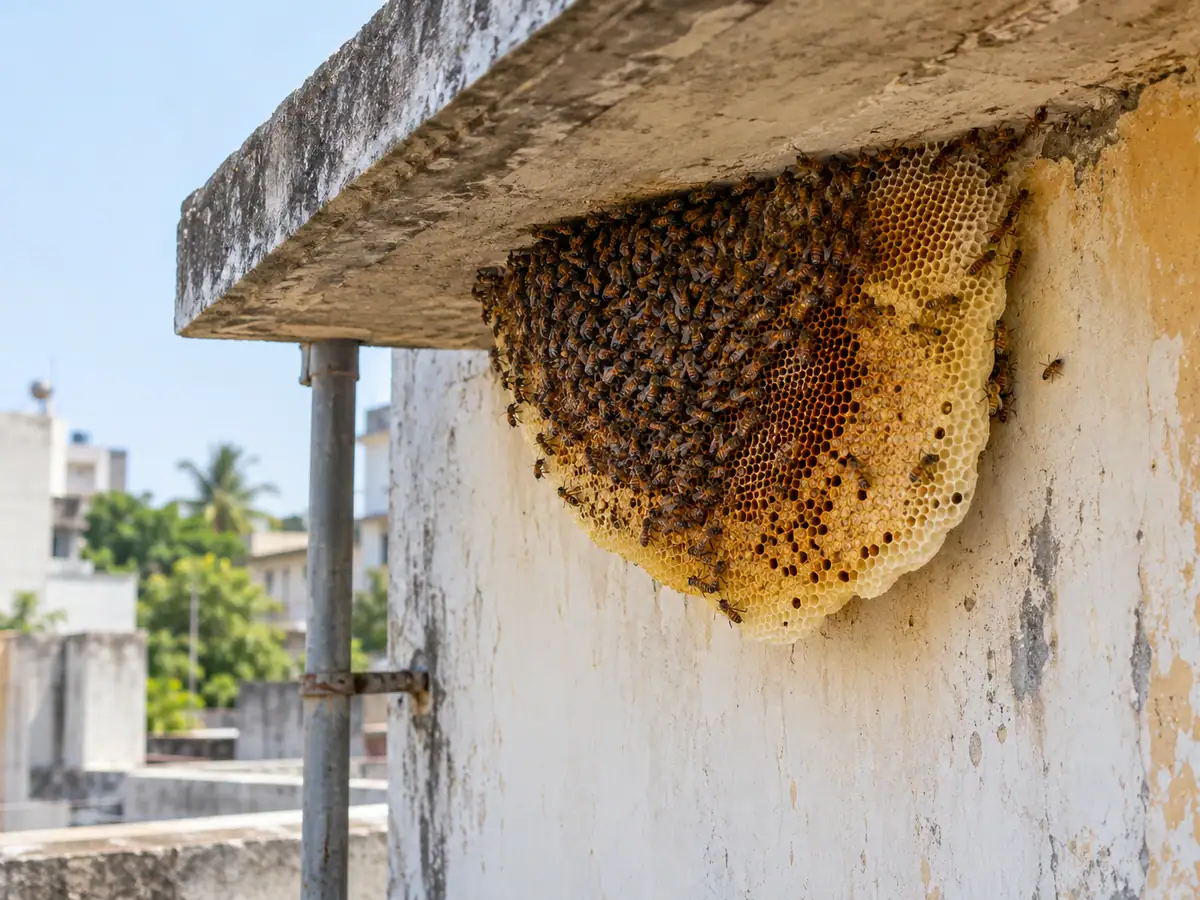
Honeycomb attached to a terrace wall before removal

Temporary Honey Bee Swarm

A temporary honey bee swarm often appears as a dense cluster on a tree branch, shrub, fence, exterior wall, or outdoor fixture. The queen and worker bees rest together while scout bees search for a permanent nest cavity.

A newly arrived swarm usually has little or no comb at the resting point. Early honey bee swarm removal is generally simpler because the bees may still be collected, contained, and transferred into a managed hive box without structural access.

Keep children, pets, workers, and pedestrians away from the cluster. Do not spray, strike, burn, hose, or disturb the bees.

Established Honey Bee Colony

An established honey bee colony occupies a cavity and shows repeated entrance traffic. Worker bees may carry pollen through a hole in a wall, roofline, ceiling edge, duct, tree trunk, or utility enclosure.

Common signs include:

  • Bees repeatedly entering one opening
  • Buzzing, warmth, or a honey-like odour
  • Bees appearing inside rooms
  • Honey or wax staining a wall or ceiling
  • Defensive activity near the hive entrance
  • Comb, brood, pollen, and honey inside the cavity

An established colony requires a detailed structural inspection because its honeycomb may extend beyond the visible entrance.

Locations We Inspect and Service

Honey bees select cavities that provide shelter, stable temperatures, and a small entrance. Kharadi Pest Control assesses accessible colony locations in residential and commercial properties, including:

  • Wall gaps and exterior cladding
  • Rooflines, roofing gaps, and eaves
  • Ceiling edges and fascia boards
  • False ceilings and ceiling spaces
  • Active or unused ducts
  • Parking areas, sheds, and outbuildings
  • Trees and hollow trunks
  • Utility and meter boxes
  • Fences, shrubs, and tree branches
  • Offices, shops, warehouses, and commercial buildings

Service feasibility depends on height, access, construction material, colony depth, hidden utilities, fall-protection needs, and repair requirements.

Our Bee Removal Process

Our bee removal process connects insect identification with colony location, removal, hive-material clearance, and entry-point exclusion.

1

Identify the Insects

Insect identification confirms whether the activity involves honey bees, bumble bees, carpenter bees, wasps, hornets, or yellowjackets. We review photographs, observe flight patterns, inspect pollen-carrying activity, and assess defensive behaviour around the opening.

Correct identification prevents the wrong treatment and helps determine the correct removal method.

2

Inspect and Locate the Colony

A structural inspection traces the active hive entrance and establishes whether the bees are clustered outside or nesting inside a cavity. The inspection considers:

  • Colony size, activity level, and temperament
  • Entrance height, size, and number of openings
  • Honeycomb placement and attachment points
  • Brood, pollen, beeswax, and honey stores
  • Access through the interior or exterior surface
  • Electrical wiring, plumbing, and hidden hazards
  • Required access opening and repair responsibility

These findings define the removal estimate, labour scope, equipment, exclusion work, and repair exclusions.

3

Select the Removal Method

The removal method must match the colony’s location, accessibility, condition, and behaviour. Depending on the inspection, the recommendation may include:

  • Removal of the swarm or accessible bees
  • Structural access to the nest cavity where required
  • Approved control treatment where suitable
4

Remove the Bees and Hive Material

Complete hive removal addresses both the adult bees and the material stored inside the nest cavity. Where accessible, the work may include collecting the bees, locating the queen, detaching comb, removing brood, clearing pollen stores, recovering or disposing of honey, scraping wax, and removing dead-bee debris.

5

Clean and Bee-Proof the Site

Bee-proofing closes confirmed access points after the colony and accessible hive material have been removed. The work may include cleaning residue, sealing gaps, screening ventilation openings, and identifying damaged ceiling edges, exterior cladding, roofing, or wall sections that require repair.

Openings must not be sealed while an active colony remains inside. Trapped bees may enter occupied rooms, create new exit points, or leave abandoned comb within the structure.

Why the Entire Hive Should Be Addressed

Complete hive removal reduces the problems caused by abandoned colony material. Honey bees do not normally eat or destroy structural timber, but honey, wax, brood, pollen, and dead bees can remain inside the building after the insects leave or die.

Unremoved material can:

  • Leak or stain walls and ceilings
  • Ferment and produce persistent odours
  • Attract ants, beetles, wax moths, rodents, and other scavengers
  • Draw robbing bees to the old nest
  • Retain colony odours that attract another swarm
  • Contaminate insulation or interior finishes
  • Cause recurring bee activity in the same cavity

Residential and Commercial Bee Removal

Residential bee removal addresses swarms and colonies at houses, apartments, parking areas, rented homes, sheds, and housing societies. We assess occupied areas, indoor bee activity, access height, wall construction, and the safest route for removal work.

Commercial bee removal addresses offices, retail properties, warehouses, hospitality sites, schools, industrial facilities, and managed property portfolios. The inspection considers pedestrian movement, restricted access, work scheduling, flight paths, and the location of entrances near customers or employees.

What to Do Before Help Arrives

Safe preparation limits disturbance and helps the removal specialist inspect the site accurately.

  • Keep children, pets, staff, and visitors away.
  • Close nearby windows and doors.
  • Restrict activity below or beside the flight path.
  • Do not spray insecticide, smoke the cavity, strike the wall, or burn the nest.
  • Do not plug the entrance while bees are active.
  • Photograph the cluster or entrance from a safe distance.
  • Note how long the activity has been present.
  • Report indoor bees, difficult access, and known sting allergies.
  • Move away calmly if the bees become defensive.

Anyone experiencing widespread swelling, breathing difficulty, dizziness, or another serious reaction after a sting should seek emergency medical care immediately.

What Affects Honeybee Removal Cost?

Honeybee removal cost reflects the inspection findings and the work required to clear the location safely. A visible swarm on a low branch usually requires a different scope than a large honey bee hive inside a wall or roof.

An estimate may consider:

  • Swarm versus established colony
  • Nest location and colony depth
  • Population and comb volume
  • Height and physical accessibility
  • Required wall, ceiling edge, or roof access
  • Honey, pollen, brood, and wax removal
  • Ladder, access, and protective-equipment needs
  • Entry-point sealing and exclusion work
  • Repair or restoration responsibilities
  • Monitoring and follow-up visits

Request an inspection for an accurate bee removal estimate or cost to remove bees from a wall.

Why Choose Kharadi Pest Control?

Kharadi Pest Control follows a direct, solution-oriented process: identify the insect, locate the colony, select the removal method, clear accessible hive material, and close confirmed entry points.

Customers receive a clear explanation of the findings, proposed work, access requirements, removal limitations, repair responsibilities, and preventive recommendations before the job proceeds. The removal method is confirmed after the colony and site have been assessed.

Frequently Asked Questions

Are honey bees dangerous?

Honey bees usually forage without causing trouble, but workers can defend their queen, brood, honey stores, and nest entrance. Keep clear of the flight path and arrange an inspection if bees occupy a busy area or building cavity.

Is this a swarm or an established hive?

A swarm forms an exposed cluster and often has little or no comb. An established hive has repeated entrance traffic and contains comb, brood, pollen, and honey within a cavity.

Does all the honeycomb need to be removed?

Accessible honeycomb should be removed whenever practical. Remaining honey, brood, pollen, and wax can leak, smell, attract secondary pests, and encourage future bee activity.

Can I seal the entrance while bees are inside?

No. Sealing an active entrance can trap the colony, force bees into occupied rooms, and leave hive material inside the cavity.

Will you need to open the wall or roof?

A structural colony may require an access opening. Its position and size depend on the comb location, building material, utilities, and safest extraction route. Repair responsibility should be confirmed in the written scope.

Can bees return to the same location?

Yes. Residual hive odours and unsealed gaps can attract another swarm. Comb removal, cleaning, durable sealing, screening, and repairs reduce the risk of re-entry.

Do you remove wasps and hornets too?

Honey bees require different handling from wasps, hornets, yellowjackets, carpenter bees, and bumble bees. Identification during the inspection determines the correct service.

How long does removal take?

The time depends on whether the job involves a visible swarm, an established colony in a cavity, or extensive honeycomb removal. An inspection provides the most reliable timeframe.

Request a Honeybee Removal Inspection

Request a honeybee removal inspection in Kharadi, Pune if you have a swarm in the garden, bees entering a wall or roof, buzzing inside the property, indoor bee activity, or honey staining a surface.

When contacting Kharadi Pest Control, provide:

  • Property address and type
  • Location of the bees
  • Approximate access height
  • Duration of the activity
  • Visible entry point
  • Safe photographs or video
  • Details of indoor activity or sting allergies

Call Kharadi Pest Control or submit your details and photographs to request a professional bee removal assessment, removal recommendation, and written estimate.

Book an inspection

Call Now WhatsApp